

A brake pad warning light
A Qatar recall covered a fault in this warning light on 2017 to 2020 Panamera and 2018 to 2020 Cayenne models. We read the code and refer the car to a Porsche dealer for the recall.
 Porsche specialists
Porsche brake pads and disc replacement in Dubai, at Royal Prince Auto Care's DIP 2 workshop. We measure every steel and PSCB disc first.

Tell us your car, what it needs and how to reach you. A service advisor will call you back to talk through the work.
The work we carry out on Porsche models at our Dubai Investment Park workshop. Open the full details below.
A Porsche with worn or faulty brakes shows 4 signs, 2 in the instrument cluster and 2 at the wheels or pedal. The pad warning works through an electrical contact in the pad. Once the friction material wears down to it, the contact closes a circuit and the warning lights up.
A Qatar recall covered a fault in this warning light on 2017 to 2020 Panamera and 2018 to 2020 Cayenne models. We read the code and refer the car to a Porsche dealer for the recall.
On the 718 (982), Porsche links this message to a damaged main wire harness in the rear wheel housings. We read the fault memory, check that harness and repair the damaged wires.

On a Cayenne (9YA) with PSCB brakes, Porsche traces a front squeal, with or without the pedal pressed, to the pad geometry. Its fix is a front pad set with a modified geometry, and we fit that pad set.
A Qatar recall covered front brake hose fitting on 2020 to 2025 Taycan models, a fault that risks weaker braking and a changed pedal feel. A Saudi recall named possible cracks in the front hoses of 109 Taycan. We inspect both front hoses for cracks and leaks and replace a damaged hose.
We work through these items in our Porsche brake pads and disc replacement in Dubai:
We replace both discs on an axle together, with new pads, even when one disc alone has reached its limit. On a 992 GT3 with PCCB, Porsche's pad change takes 2 new wear indicators per axle.
Porsche brake pads and discs in Dubai wear from 6 causes. Every stop turns the car's speed into heat at the pads and discs, and heat, standing time and light use do the damage. The brake system decides which cause matters most: cast-iron steel, tungsten carbide-coated PSCB or ceramic composite PCCB.
We check steel discs for blue heat marks and rust and the discs of a Taycan or Macan Electric for corrosion. A disc that fails its measurement is replaced.
Each Porsche brake job we finish keeps these results for the driver:
The car stays put on a slope, and Dubai's periodic vehicle test includes parking brake performance.

A PSCB brake makes 90% less brake dust than a grey-iron brake, so the wheels stay cleaner between washes.
PSCB discs last 30% longer than grey-iron discs, so a set of discs stays on the car longer.
On a Cayenne (9YA) with PSCB brakes, the modified front pad set ends the squeal Porsche traces to pad geometry.
Undamaged front brake hoses keep a Taycan clear of the weaker braking and changed pedal feel that a hose fault risks.
The electric brake booster of the updated Cayenne E-Hybrid blends friction braking with energy recovery, and the driver feels a consistent pedal.
PCCB and PSCB brakes differ from Porsche's cast-iron steel brakes in disc material and calliper colour. PCCB discs are ceramic fibre-reinforced composite behind yellow callipers. PSCB discs are cast iron with a tungsten carbide coating, behind white callipers, while steel brakes keep plain cast-iron discs.
A PCCB disc weighs around 50% less than a cast-iron disc. PCCB is standard on the 911 Turbo S and optional on the 911 GT3. A 992 GT3 runs 410 mm front and 390 mm rear PCCB discs.
PSCB arrived in 2017 as standard on the Cayenne Turbo (E3), with ten-piston front and four-piston rear callipers. On a Cayenne (9YA), a green PSCB calliper is also listed.
The low unsprung weight of a PCCB system lets the suspension react more quickly and accurately to the road. PCCB discs and pads are less prone to absorbing water, so they respond with minimal delay in wet weather. A PCCB brake gives full deceleration almost at once, without heavy pedal pressure.
We refer PCCB disc and pad work to a Porsche dealer, and measure the friction material left on steel and PSCB pads.
A Porsche rear brake job needs diagnostics when the car has an electric parking brake, because that brake works through the rear callipers. A diagnostic tool sets it to pad-changing mode before the pads come out and calibrates it once the new pads are in. On the Panamera (971), that calibration follows any pad or disc change.
On affected Panamera (971) cars, a software error blocks the calibration, and Porsche's fix is new software for the parking brake control unit. We read the code and refer the car to a Porsche dealer for the update. On every other Porsche with an electric parking brake, we carry out both diagnostic steps.
These are the steps of a Porsche brake job in our workshop.
We drive the car to confirm the complaint and to rule out a worn suspension part as its cause. Back in the bay, we read the fault memory for pad and parking brake entries.
A gauge reads each cast-iron disc at 4 points at least, and the lowest reading counts. That reading is set against MIN TH, the wear limit in millimetres stamped on the disc. The pad measurement then confirms or clears a Porsche pad warning.
We check each piston, seal and slide pin and clean the piston faces. On a PSCB brake, each new pad is centred in the calliper before it is stuck to the piston, as Porsche's PSCB instructions set out.
Rust and dirt come off the hub face, and each new disc runs within 0.10 mm of true. On an updated Cayenne S, those discs measure 410 mm at the front and 358 mm at the rear.
We fit the new pads and watch the fluid reservoir, whose level rises as the pistons go back.
We bleed any system we opened. During the road test, we never stab the pedal or hold it down longer than 3 seconds, and we listen for noise and vibration.
To book a Porsche brake check, call or message us with the model and what the car does.
The cost of Porsche brake pads and disc replacement in Dubai rests on 4 factors: brake system, parts, axle and extra repairs. Steel and PSCB parts differ, and a job covers pads alone or pads with discs. Our inspection on the car shows which factors apply.
These practices apply to every Porsche brake job in our workshop:
We look up Porsche's technical information for the symptom, and Porsche's remedy sets the repair.
The calliper colour and the car's equipment tell us whether it has steel, PSCB or PCCB brakes.
A PSCB disc needs special brake pads of its own, developed alongside its tungsten carbide coating. We never swap pads between steel and PSCB brakes.
We order brake parts by the Porsche type code, such as 9YA for a Cayenne or 971 for a Panamera.
On the Cayenne, Porsche specifies a charger rated 90 A or more with a lithium charge map, and we connect one during diagnostic work.
A Saudi recall covered the wheel-bolt fastening on 62 Carrera 911 cars of the 2024 model year. Every Porsche wheel bolt we fit is tightened in sequence with a torque wrench.
We service the brakes on these Porsche ranges, listed with Porsche's type codes:
Porsche brakes last longer in Dubai with 4 habits that act on the fluid, the pads and the discs. Brake fluid absorbs water over time, which lowers its boiling point, and new pads need a gentle start to bed in. We note the brake system and the fluid age on each Porsche we service.
A 911 or 718 in the Middle East is due a brake fluid change every 2 years. At each brake check we test the boiling point, and fluid below 180 °C is replaced.
New pads and discs follow the car maker's bedding-in procedure first. Without one, the pads get 200 km or more of light braking. On a PSCB car, the pads polish the disc to a mirror shine after about 6,000 km.

A Cayenne from the 2018 model year in the Middle East is due an inspection every 30,000 km, or every 2 years at the latest. Each inspection is the point for a brake check.
PCCB discs last for long periods when they are used mainly on the road and maintained correctly.
Tell us the make, model and what the car is doing, and we book it in at our Dubai Investment Park 2 workshop. Free pickup and drop-off by our driver comes with a service contract. Every service comes with a free car wash.
Regular servicing keeps small faults from turning into big repairs. Both packages are carried out by certified technicians using genuine or quality parts.
Each package is quoted for your car. Call +971 50 216 0864 with the make and model for an estimate.
Reviews left on our Google listing, in the reviewers' own words.
632 Google reviews
“I had my MG HS Trophy serviced at 70,000 km at Royal Prince Maintenance Workshop. The workshop manager and service advisor were helpful and supportive throughout, and the technical team was very experienced. They explained the service clearly and completed the work on time. I’m very happy with the experience and highly recommend this workshop.”
 Tarik Ele on Google
“Well explained the issue of the car, fast and reliable. Thanks to staff named Nikhil Mehta who handle my car. Highly recommended.”
 noriel comia on Google
“Royal Prince Auto Care in Dubai Investment Park is truly one of those rare places where you get both quality and cost-effectiveness together. In today’s market, finding a workshop that genuinely cares for your vehicle, maintains good service standards, and still keeps the pricing reasonable is not easy. But Royal Prince Auto Care has managed to give me that confidence. All my vehicle care and service work is being handled by Royal Prince Auto Care, and I must give special compliments to their workshop team. Their approach is professional, honest, and very customer-focused. From the way they inspect the vehicle to the way they explain the work required, everything feels transparent and well-managed. The service level at this place is impressive. Whether it is regular maintenance, repairs, body work, detailing, or general vehicle care, they handle things with proper attention and responsibility. The team makes you feel that your vehicle is in safe hands, and that peace of mind matters a lot. What I appreciate most is that they do not compromise on quality while still being cost-effective. That combination is barely hard to find, but I found it here. The workshop team deserves special appreciation for their effort, patience, and quality of work. A reliable, professional, and value-for-money auto care centre in Dubai. Highly recommended for anyone looking for trustworthy vehicle service with excellent workshop support.”
 Srijith Pillai on Google
“⭐️⭐️⭐️⭐️⭐️ "I’ve been servicing my vehicle at Royal Prince Auto Care for over two years, and the experience has consistently been top-tier. The team is incredibly professional, providing clear communication and keeping me updated at every stage of the service. Their attention to detail and genuine commitment to vehicle health have truly earned my trust. A special shout-out to Mr. Bharath and Mr. Nikhil—their expertise, smart approach, and dedication to their work are unmatched. Thank you both for your endless support and excellent service! Highly recommend this team to anyone looking for reliable and quality car care.”
 AJAY FRANCIS on Google
“Now I have BMW Z4, before Wrangler Jeep, Mini Couper, I always prefer this car service center! They are very trustworthy and all the technician are very knowledgeable! Special thanks to Mr. Nikhil Mehta , the way he treat the customer, amazing 😍!so thanks and keep it up”
 Debendra MishraEdited on Google
“I own a Mercedes GL500 and recently had suspension and A/C work done at Royal Prince Auto Care. The whole experience was excellent from start to finish. The team was very responsive, attentive, and professional. They clearly explained the work needed on my vehicle and completed everything to a high standard. A special thanks to Mr. Nikhil, who took the time to explain the repairs and procedures in a simple way. Throughout the process, he kept me updated with videos and detailed information about the condition of the old parts, which gave me a lot of confidence and transparency. Special mention to Mr. Bharath for taking the time to do the test drive with me before and after the repairs. He helped me better understand my vehicle and made sure everything was working perfectly. Thank you, Royal Prince Auto Care, for the great service. It's not easy to find a reliable garage, and I'm glad I found one. I highly recommend this garage to anyone looking for a one-stop solution for their vehicle maintenance and repairs.”
 Kousic S Nair on Google
“I was referred to Royal Prince Auto Care by a colleague, and I decided to take my Hyundai Santa Fe there for service. I am extremely satisfied with the quality of service I received. The team at Royal Prince Auto Care is professional, knowledgeable, and genuinely committed to customer satisfaction. A special thanks to Mr. Bharath for his exceptional support and attention to detail. His professionalism, friendly approach, and clear communication made the entire experience smooth and hassle-free. The care and dedication shown toward my vehicle were truly impressive, and it gave me great confidence in their workmanship. Based on my experience, I would highly recommend Royal Prince Auto Care to my friends, colleagues, and anyone looking for reliable and trustworthy automotive service. Thank you Bharath and the entire team for the excellent service. Keep up the great work! ⭐⭐⭐⭐⭐”
 Jibin Joseph on Google
“I have been servicing and maintaining my vehicle with Royal Prince Auto Care, and I am extremely impressed with the quality of their work. The level of care and attention they give to every vehicle is truly exceptional. Their team is highly knowledgeable, professional, and always willing to help. Whether it's a minor repair, routine maintenance, or a major job such as an engine overhaul, they handle every task with expertise and precision. What stands out most is their commitment to customer satisfaction and their ability to diagnose and resolve issues efficiently. I have always had a great experience with them and can confidently recommend Royal Prince Auto Care to anyone looking for reliable and trustworthy automotive service. Kudos to the entire team for their outstanding work and dedication! ⭐⭐⭐⭐⭐”
 Swalih Shalu on Google
“I have been a customer of Royal Prince Auto Care since 2021 when I owned a Nissan X-Trail, and from day one I have consistently received outstanding service. Their professionalism, attention to detail, and commitment to quality have always impressed me. For the past two years, I have owned a Toyota RAV4, and despite purchasing it brand new, I have chosen to service it exclusively at Royal Prince Auto Care rather than at the dealership. The confidence I placed in their team has been fully justified. They have maintained my vehicle to such a high standard that it feels every bit as well cared for as an agency-maintained car. A special thanks to Mr. Bharath for his exceptional support and dedication in keeping my vehicle in top-notch condition. His expertise, honesty, and customer-focused approach make every visit a great experience. I highly recommend Royal Prince Auto Care to anyone looking for reliable, professional, and high-quality vehicle maintenance services. In fact, many of my colleagues and friends have also become customers after hearing about my positive experiences.”
 justine tharu p on Google
“I have used Royal Prince Auto Care a couple of times, and even during my very first visit, I was genuinely impressed by the team. The reception staff, especially Nikhil, Nikhil Mehta, and Bharath, made the entire experience smooth and welcoming. Their professionalism, friendly approach, and willingness to assist customers truly stand out. One thing I really appreciate about Royal Prince Auto Care is their transparency. Unlike many workshops that don’t allow customers into the work area, they are completely open and let you see the work being carried out on your vehicle, which builds a great deal of trust and confidence. The technicians are also very skilled and approachable. A special mention to Sukhwinder, the Punjabi technician who handled my wheel alignment with great precision and professionalism. Overall, Royal Prince Auto Care offers reliable service, honest communication, and a customer-friendly environment. I highly recommend them to anyone looking for a trustworthy and transparent garage for their vehicle maintenance and repairs.”
 Amruth Vyshakh on Google
Most recent first.
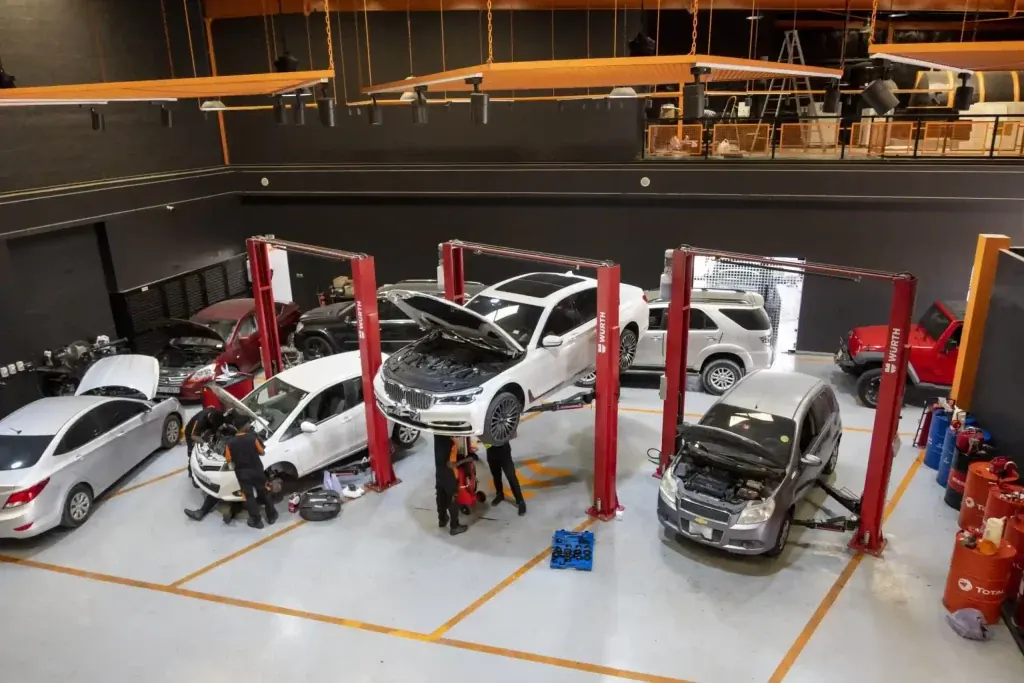
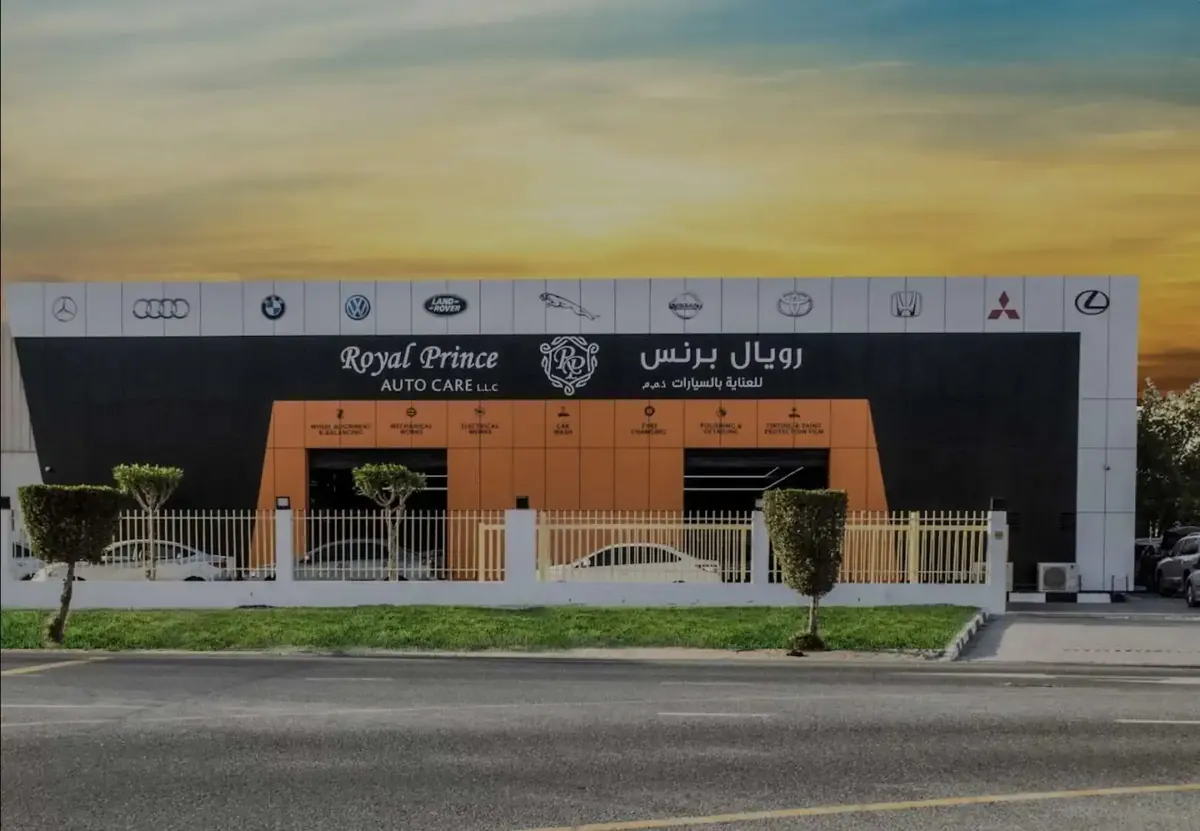
Dubai Investment Park 2. Ramps, a body shop and a detailing bay, all in one place.
Porsche pads are due when the pad warning comes on, or earlier when a measurement shows the friction material at its limit. Front and rear pads wear at different rates, so each axle is judged on its own. We measure both axles at every brake check.
Yes. A PCCB disc wears differently from a steel disc. Its weight falls about 1.25% over its whole life, so wear is judged by weighing the disc or with a dedicated gauge.
Yes. The electrical wear contact is part of the pad change on a Porsche, so the old indicator comes out with the old pads.
No. A Porsche brake job on steel or PSCB brakes, diagnostic steps included, is work for an independent workshop such as ours in DIP 2. PCCB pad and disc work goes to a Porsche dealer.
Yes. Brake fluid comes in DOT classes, and a lower class than the car maker specifies is unsafe. We never fit a lower DOT class than the one Porsche specifies.
Call or send a WhatsApp message with your Porsche model, its year and what the car is doing, and book it in at our Dubai Investment Park 2 workshop.